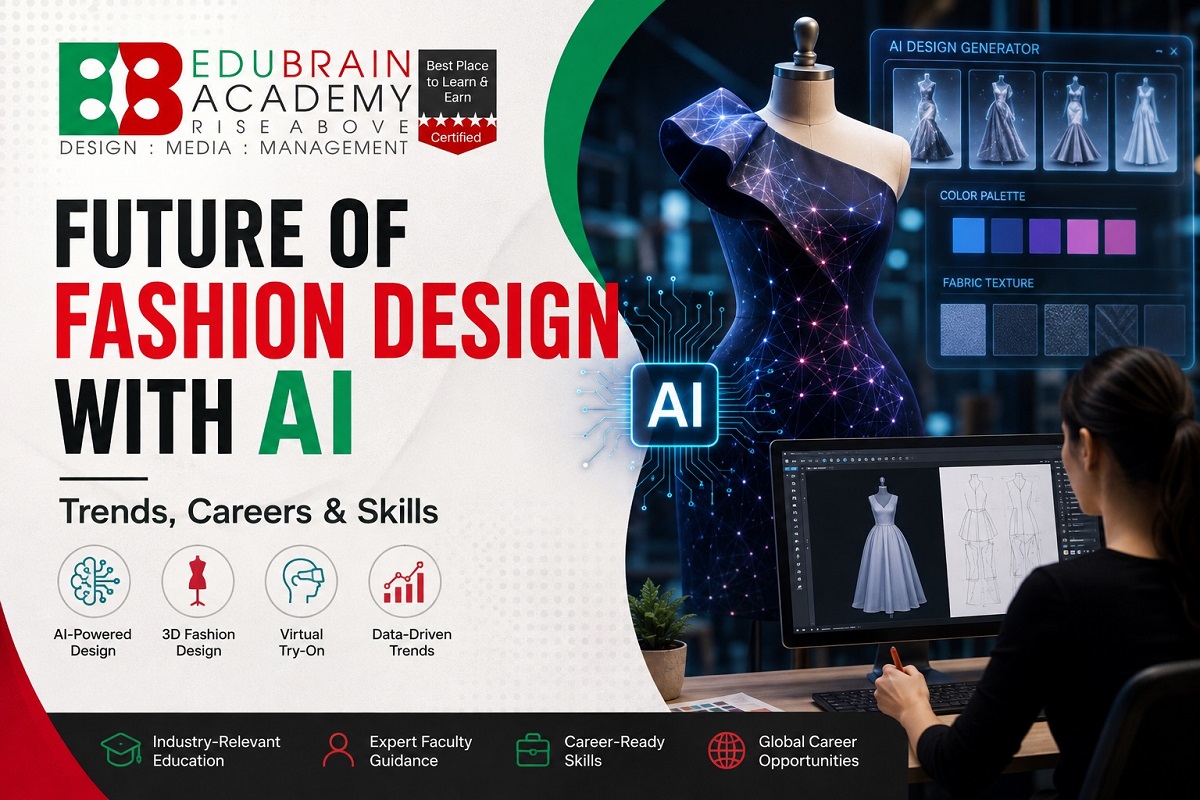
Artificial intelligence (AI) is transforming the fashion industry at almost every stage, from researching trends and developing concepts to creating digital garments, personalizing shopping experiences and analyzing consumer preferences. Technologies such as generative AI, 3D fashion design, virtual try-on and data-driven forecasting are becoming increasingly relevant to modern fashion businesses.
The Future of Fashion Design with AI is not about replacing creativity with technology. Instead, it is about combining human creativity, fashion knowledge and digital tools to make the design process more efficient, experimental and responsive to changing consumer expectations.
For students, this transformation creates new possibilities. Traditional knowledge of textiles, garment construction, pattern making, illustration and styling remains important, but these skills can now be combined with digital design, 3D visualization and responsible use of AI.
This guide explains how artificial intelligence is changing fashion design, the latest technology-driven trends, essential skills for future designers, emerging career opportunities and what students should consider when preparing for a career in the fashion industry.
What Is AI in Fashion Design?
Artificial intelligence in fashion design means using artificial intelligence to support creative, technical, analytical or commercial activities within the fashion industry.
Depending on the application, AI can assist with:
-
Fashion concept development
-
Trend research
-
Color exploration
-
Print and pattern experimentation
-
Textile design
-
Digital fashion illustration
-
3D garment visualization
-
Virtual try-on
-
Fashion styling
-
Personalized recommendations
-
Consumer analysis
-
Fashion marketing
Generative AI can produce visual concepts from written prompts or reference material. Other AI systems can process large amounts of information to identify patterns in customer behavior and market activity.
However, AI-generated content is not automatically a finished fashion product. A professional designer must still evaluate whether an idea is practical, visually appropriate, technically possible and suitable for the intended customer.
This makes fashion knowledge more valuable, not less important.
How AI Is Changing Fashion Design
Artificial intelligence is influencing the fashion-development process in several ways. Some applications focus on creativity, while others support research, production, retail and customer experience.
AI for Fashion Inspiration
Fashion designers traditionally spend considerable time researching references, building mood boards and exploring different visual directions.
Generative AI can help accelerate this initial stage by allowing designers to experiment with multiple concepts.
For example, a designer can explore different:
-
Silhouettes
-
Color palettes
-
Textures
-
Prints
-
Styling approaches
-
Collection themes
-
Visual aesthetics
The designer can then select the strongest ideas and develop them through traditional design methods.
The important point is that Artificial intelligence provides possibilities, while the designer provides creative direction.
AI for Trend Research
Fashion trends are influenced by culture, entertainment, social media, consumer behavior, technology and changing lifestyles.
AI can process large amounts of information and identify patterns that may support trend research.
Fashion businesses can use technology to study:
-
Consumer interests
-
Product demand
-
Color preferences
-
Seasonal behavior
-
Online engagement
-
Emerging aesthetics
-
Market patterns
AI does not guarantee that every prediction will become a successful trend. Fashion can change because of unexpected cultural events and social developments.
Human interpretation is therefore still essential.
AI for Textile and Print Development
Textile and print designers can use AI-assisted tools to experiment with different visual concepts before developing final designs.
Applications may include:
-
Surface patterns
-
Repeating motifs
-
Abstract prints
-
Geometric designs
-
Embroidery concepts
-
Decorative elements
-
Color combinations
A digitally generated pattern still needs to be assessed against actual production requirements.
For example, a pattern that looks effective on a screen may not work equally well with a particular printing process, embroidery technique or fabric.
Understanding materials and production therefore remains essential.
AI for Fashion Illustration
Digital illustration has already become an important part of modern fashion workflows.
AI can support designers by helping them explore different poses, styling concepts, garment variations and visual directions.
However, students should continue developing traditional drawing skills.
Knowledge of anatomy, proportion, garment structure, composition and visual storytelling allows designers to evaluate whether an AI-generated image accurately communicates their idea.
AI and 3D Fashion Design
3D technology is changing the way garments can be developed and presented digitally.
Instead of producing every design variation as a physical sample, designers can create digital garments and visualize them on avatars.
A typical digital workflow may involve:
-
Developing the initial design concept.
-
Creating the garment digitally.
-
Applying fabric characteristics and colors.
-
Visualizing the garment on a digital avatar.
-
Adjusting proportions and details.
-
Creating digital presentations.
-
Developing a physical sample when required.
AI can complement this workflow by assisting with concept generation, visual experimentation and digital presentation.
For fashion students, learning 3D visualization can provide an additional skill that connects traditional design knowledge with emerging technology.
AI-Powered Virtual Try-On
Virtual try-on is becoming increasingly important in digital fashion retail.
The technology allows customers to visualize how clothing may appear on themselves or on a digital representation before purchasing.
This can support:
-
Online product visualization
-
Customer engagement
-
Digital styling
-
Product discovery
-
Personalized shopping
-
E-commerce experiences
Google has also introduced AI-powered virtual apparel try-on technology in India, demonstrating how artificial intelligence is being applied to online fashion shopping.
As these systems develop, fashion professionals may increasingly need to understand how products are represented digitally as well as physically.
AI and Personalized Fashion
Personalization is another important area where AI is influencing fashion.
Consumers increasingly expect brands to provide products and recommendations that match their individual preferences.
AI can analyze information such as:
-
Previous purchases
-
Browsing behavior
-
Product interactions
-
Style preferences
-
Color preferences
-
Shopping patterns
This information can help brands personalize recommendations and improve the online shopping experience.
For fashion designers, this development highlights the growing importance of understanding the relationship between design, consumer behavior and technology.
AI and Sustainable Fashion
AI can potentially support more efficient fashion processes.
Possible applications include:
-
Demand forecasting
-
Inventory planning
-
Digital sampling
-
Material planning
-
Pattern optimization
-
Waste reduction
-
Consumer-demand analysis
Digital prototyping can allow designers to explore multiple options before creating physical samples.
However, AI should not automatically be described as a complete sustainability solution.
Fashion's environmental impact depends on materials, manufacturing, transportation, consumption and disposal. Technology can contribute to efficiency, but its sustainability value should be evaluated through actual outcomes.
Top AI Trends Shaping Fashion
The fashion industry is likely to see continued development across several technology areas.
1. Generative Fashion Design
Generative AI allows designers to explore many visual concepts during the early stages of creative development.
2. AI-Based Trend Analysis
AI can process large datasets to identify patterns that may assist fashion research and market analysis.
3. Virtual Try-On
AI-powered virtual try-on can improve digital product visualization and help consumers evaluate products online.
4. AI Fashion Styling
AI can assist with personalized outfit combinations based on clothing, accessories and customer preferences.
5. Digital Fashion
Digital garments can be developed for virtual environments, social platforms, gaming, marketing and other digital experiences.
6. AI-Assisted Textile Design
Generative technology can help designers experiment with prints, motifs and surface patterns.
7. Personalized Shopping
AI can help fashion retailers tailor product recommendations to individual consumers.
8. Intelligent Retail
AI is increasingly connecting product development, merchandising, customer experience and digital commerce.
Together, these developments are creating a fashion environment where creative and digital skills increasingly overlap.
Future of Fashion Design with AI: What Students Need to Know
Artificial intelligence is changing how fashion concepts are researched, developed, visualized and presented. Students who understand traditional fashion principles alongside emerging digital technologies can prepare themselves for the changing requirements of the fashion industry.
Will AI Replace Fashion Designers?
The Future of Fashion Design with AI will increasingly involve collaboration between designers and intelligent digital tools. AI can support concept development, trend research, digital visualization and personalization, while designers continue to control creative direction, technical decisions and final outcomes.
AI is unlikely to eliminate the need for fashion designers entirely.
Fashion design involves much more than creating an attractive digital image.
Professional designers need knowledge of:
-
Textiles
-
Pattern making
-
Garment construction
-
Fit
-
Color
-
Proportion
-
Consumer behavior
-
Manufacturing
-
Brand identity
-
Cultural context
An AI system may generate a visually impressive garment that is difficult to manufacture or unsuitable for a particular fabric.
A trained designer can identify those limitations and improve the concept.
The more realistic future is human-AI collaboration, where technology supports repetitive or exploratory tasks while designers remain responsible for creative direction and final decisions.
Skills Future Fashion Designers Will Need
The next generation of fashion professionals will benefit from a combination of traditional, creative, technical and digital skills.
Strong Fashion Fundamentals
Students should develop a solid understanding of:
-
Fashion illustration
-
Textiles
-
Color theory
-
Pattern making
-
Draping
-
Garment construction
-
Design principles
-
Fashion history
These fundamentals help designers evaluate whether technology-generated concepts actually work as fashion products.
Digital Design Skills
Digital skills may include:
-
CAD
-
Digital illustration
-
3D fashion software
-
Digital pattern development
-
Image editing
-
Presentation design
Specific software can change, but digital confidence and adaptability will remain valuable.
AI Literacy
Fashion students should understand the practical use and limitations of AI.
Important areas include:
-
Prompt development
-
AI image generation
-
Concept exploration
-
Visual refinement
-
AI limitations
-
Copyright considerations
-
Responsible AI use
Students do not need to become programmers to benefit from these technologies.
Creative Direction
When technology makes it easier to produce ideas, selecting the right ideas becomes increasingly important.
Creative direction includes:
-
Developing a concept
-
Establishing a visual identity
-
Selecting appropriate ideas
-
Building cohesive collections
-
Creating visual stories
-
Maintaining brand consistency
Critical Thinking
AI can produce inaccurate or unrealistic outputs.
Designers therefore need to evaluate whether a result is:
-
Technically practical
-
Visually appropriate
-
Original
-
Relevant to the target customer
-
Suitable for production
Communication Skills
Fashion professionals work with manufacturers, buyers, clients, stylists, photographers, marketers and production teams.
Clear communication remains an important professional skill regardless of how advanced technology becomes.
Future of Fashion Design Course
Students researching a Future of Fashion Design Course in Delhi should examine the actual curriculum instead of focusing only on the course title.
A future-focused program should ideally combine traditional fashion education with relevant digital skills.
Students can look for exposure to:
-
Fashion illustration
-
Textile studies
-
Pattern making
-
Garment construction
-
Fashion styling
-
CAD
-
Digital design
-
3D visualization
-
AI-assisted creative workflows
-
Portfolio development
-
Industry projects
-
Internships
It is also important to understand how technology is taught.
Simply mentioning AI in a syllabus does not necessarily mean students will gain meaningful practical experience. Students should look for programs where digital tools are connected to actual design projects.
What Students Should Look for in a Fashion Design Institute
Choosing a fashion institute requires more than comparing names.
Students should evaluate the curriculum, practical training, faculty, facilities and opportunities for portfolio development.
Those looking for the Best Fashion Design College in Delhi should compare institutions based on their actual learning environment and career objectives rather than relying only on promotional claims.
Important factors include:
-
Course structure
-
Practical assignments
-
Faculty experience
-
Design facilities
-
Digital infrastructure
-
Industry exposure
-
Workshops
-
Internships
-
Portfolio development
-
Career guidance
Students should also check whether the institute provides opportunities to work on real or industry-oriented projects.
Fashion Education Across Delhi NCR
Students considering institutes across the wider region should compare course duration, curriculum, practical exposure, digital learning, internships and career support.
When evaluating the Best Fashion Design College in Delhi NCR, students should also consider whether the curriculum matches their intended specialization and whether the institute provides opportunities to develop both traditional and digital fashion skills.
A strong comparison should focus on educational quality rather than simply selecting an institute because of its location or marketing claims.
Fashion Education Options Across India
Students exploring fashion education nationally have many different choices.
There is no single institution that will be the right fit for every student.
Someone interested in apparel design may have different requirements from a student interested in styling, textile design, merchandising, digital fashion or fashion entrepreneurship.
Students researching the Best Fashion Design College in India should therefore compare:
-
Specializations
-
Curriculum
-
Practical training
-
Faculty
-
Industry exposure
-
Digital facilities
-
Fees
-
Portfolio opportunities
-
Career support
The right institution should match the student's academic interests, budget and long-term career plans.
Edu Brain Academy and Future-Focused Fashion Education
Students interested in combining traditional fashion education with contemporary creative skills can evaluate programs based on curriculum, practical learning and industry-oriented exposure.
Edu Brain Academy focuses on design education and provides students with opportunities to develop creative, practical and industry-relevant skills.
When evaluating any fashion institute, students should independently review the curriculum, course structure, practical facilities, faculty, portfolio opportunities and career support before making an admission decision.
Emerging Career Opportunities in the AI Era
Artificial intelligence is changing existing fashion roles while also supporting new areas of professional work.
AI-Assisted Fashion Designer
Designers can use AI for concept exploration, visual development and collection planning.
Digital Fashion Designer
Digital fashion professionals create garments and visual experiences for digital platforms and virtual environments.
3D Fashion Designer
These professionals work with digital garments, avatars and three-dimensional product visualization.
Fashion Technology Specialist
This emerging field combines fashion knowledge with technology and digital product development.
AI Fashion Stylist
AI-assisted styling systems can help create personalized outfit recommendations.
Fashion Trend Analyst
Professionals can combine fashion knowledge with data-supported research to study consumer and market trends.
Digital Fashion Content Creator
Fashion professionals can use digital tools to develop campaigns, visual concepts and online content.
Students who want to explore the wider range of roles available in the fashion industry can read Fashion Designing Career Opportunities.
How Students Can Prepare for AI-Driven Fashion Careers
Students do not need to master every AI platform.
Instead, they should focus on developing adaptable skills that remain useful as technology changes.
Learn Fashion Fundamentals
Strong knowledge of textiles, garment construction, pattern making and design principles provides the foundation for effective technology use.
Develop Digital Skills
Students should become comfortable with relevant design and presentation software.
Experiment With AI
AI can be used for brainstorming, visual experimentation and early-stage concept development.
Explore 3D Fashion
Learning digital garment visualization can help students understand modern fashion-development workflows.
Build a Professional Portfolio
A strong portfolio can demonstrate creative ability, technical knowledge and problem-solving skills.
A portfolio can include:
-
Research
-
Mood boards
-
Sketches
-
Digital illustrations
-
Textile experiments
-
Technical drawings
-
3D projects
-
Final garments
-
Selected technology-assisted experiments
Continue Learning
Fashion technology changes quickly. Students should develop a habit of learning new tools and understanding how they can be applied to real design problems.
Responsible Use of AI in Fashion Design
AI should support learning and creativity rather than replace genuine design development.
Use AI for Exploration
AI can provide starting points for brainstorming and experimentation.
Maintain Creative Ownership
Students should make their own creative decisions rather than accepting generated results without evaluation.
Verify Technical Information
AI-generated information can contain errors, especially when discussing technical construction or manufacturing.
Understand Copyright
Designers should learn about originality, licensing, references and responsible use of generated content.
Follow Academic and Professional Rules
Different educational institutions and employers may have their own policies concerning AI-assisted work.
Challenges of AI in Fashion Design
AI creates significant opportunities, but it also introduces challenges that future designers should understand.
Creative Similarity
Heavy dependence on similar AI systems may result in repetitive visual styles.
Copyright Concerns
AI-generated content raises continuing questions about training data, ownership and originality.
Cultural Representation
Fashion frequently uses cultural references, so designers need to approach them responsibly and respectfully.
Overdependence on Technology
Students who depend entirely on AI may fail to develop fundamental fashion skills.
Technical Limitations
AI-generated images can contain unrealistic garment construction, fabric behavior, proportions or details.
Changing Industry Requirements
As digital tools become more common, employers may increasingly value professionals who can combine creative thinking with technology.
Traditional Fashion Design and AI-Assisted Design
AI does not have to replace traditional fashion practice.
The two approaches can complement one another.
|
Traditional Approach |
AI-Assisted Approach |
|
Hand sketching |
AI-assisted concept exploration |
|
Manual research |
AI-supported research |
|
Physical sampling |
Digital prototyping |
|
Manual visual experimentation |
Generative variations |
|
Traditional styling |
AI-assisted personalization |
|
Physical presentation |
Digital visualization |
|
Designer-led decisions |
Human-AI collaboration |
A designer might begin with a hand-drawn concept, develop it digitally, experiment with AI-generated variations, visualize the garment in 3D and then refine the final product using traditional technical skills.
This approach keeps the designer at the center while using technology where it provides genuine value.
What Will Fashion Design Look Like in the Future?
Fashion is likely to become increasingly digital, personalized and technology-enabled.
Designers may use AI to explore concepts faster, study consumer preferences and create digital product experiences. 3D garments may become more common during product development, while virtual try-on could become increasingly important for online fashion retail.
At the same time, human creativity will remain central.
Fashion is not simply about generating an image of clothing. It involves understanding materials, people, culture, identity, aesthetics, manufacturing and consumer expectations.
Technology can support these processes, but designers still need to provide the creative vision and professional judgment.
Conclusion
The Future of Fashion Design with AI will be shaped by the combination of creativity, technology and human expertise. AI can make certain design processes faster and provide new ways to experiment, but strong fashion fundamentals, creative thinking and professional judgment will remain essential.
Students who combine strong fashion fundamentals with digital skills will be better positioned to adapt as the industry changes. The most valuable approach is to keep learning, experiment responsibly with emerging technologies and develop a portfolio that demonstrates genuine creative and technical ability.
Fashion will continue to evolve, but creativity, curiosity, craftsmanship and human decision-making will remain at the heart of the profession.
Frequently Asked Questions (FAQs)
1. Will AI replace fashion designers?
AI is more likely to change the way fashion designers work than completely replace them. Human creativity, technical knowledge, cultural understanding and professional judgment remain important.
2. What is the future of fashion design with AI?
The Future of Fashion with AI is expected to involve greater use of generative design, 3D fashion, virtual try-on, trend analysis, digital fashion and personalized experiences. AI is likely to support designers rather than completely replace human creativity and decision-making.
3. Is AI important for fashion design students?
AI literacy can help students adapt to changing industry workflows. However, students should develop strong fashion fundamentals before relying heavily on digital tools.
4. What skills will future fashion designers need?
Future designers can benefit from fashion fundamentals, digital design, 3D visualization, AI literacy, creative direction, critical thinking, communication and portfolio development.
5. Can AI create fashion designs?
Generative AI can create visual fashion concepts and variations. These outputs still require human evaluation, refinement and technical development before they can become practical designs.
6. What is virtual try-on in fashion?
Virtual try-on uses digital technology to help consumers visualize how clothing may appear on themselves or a digital representation before making a purchase.
7. Is 3D fashion design important?
3D fashion design can support digital garment development, visualization, product presentation and virtual fashion experiences.
8. Can AI help with fashion trend forecasting?
AI can analyze large amounts of information and identify patterns that may support trend research. Human interpretation remains necessary for final decisions.
9. Should students learn AI instead of traditional fashion design?
No. AI should complement traditional fashion education. Students still need strong knowledge of textiles, construction, illustration, pattern making and design principles.
10. How can students prepare for an AI-driven fashion career?
Students can prepare by developing strong fashion fundamentals, learning digital design tools, experimenting responsibly with AI, exploring 3D fashion, building a strong portfolio and continuing to learn.